Introduction: Understanding WhatsApp Business Limitations for Companies in 2026
WhatsApp Business Limitations for Companies have become increasingly visible as MSMEs, wholesalers, real estate firms, and growing enterprises attempt to scale beyond informal selling. Across India, especially in Tier-2 cities such as Bareilly, Moradabad, Rampur, and other parts of Western UP, many businesses rely almost entirely on WhatsApp Business as their primary digital channel. While the platform is convenient and widely adopted, it was never designed to function as a complete growth infrastructure.
At the initial stage of business, WhatsApp Business appears efficient. It allows quick replies, basic product catalogs, labels, and direct customer communication. For small traders starting out, it feels sufficient. However, serious companies aiming for structured expansion quickly encounter the boundaries of chat-based selling. WhatsApp Business Limitations for Companies become evident when businesses attempt to scale visibility, authority, and predictable lead generation.
Digital behavior across India has evolved dramatically. According to insights from Statista, consumer reliance on online research continues to grow across metro and non-metro markets. Platforms such as Google Digital Garage emphasize structured digital ecosystems rather than single-channel dependence. This shift directly highlights the risks of over-relying on messaging platforms.
In Bareilly and across Western UP, many MSMEs share product images, pricing details, and quotations exclusively through WhatsApp. While this approach may generate inquiries, it does not create searchable visibility. Customers cannot discover such businesses through Google unless they already have the phone number. This severely restricts new customer acquisition.
A structured digital presence built through integrated Creative Digital Services enables businesses to move beyond chat-based dependency. Agencies such as Innovizion Studio help MSMEs design cohesive digital systems combining branding, websites, SEO, and performance marketing.
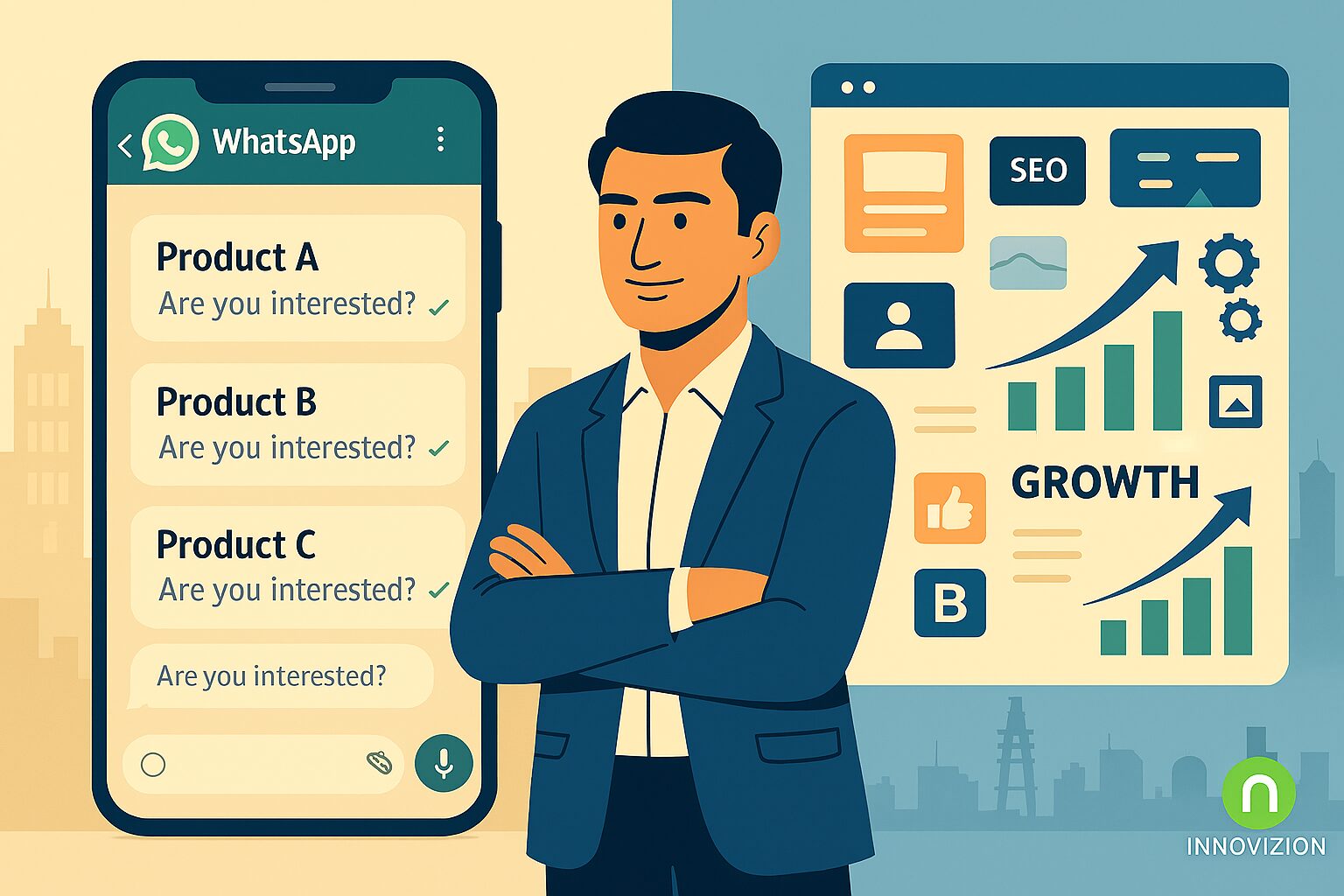
WhatsApp Business Limitations for Companies become particularly visible in three areas: discoverability, scalability, and authority. First, discoverability. WhatsApp accounts do not rank in Google search results. There is no organic search traffic. Second, scalability. Conversations are manual and linear. As inquiries increase, managing chats becomes chaotic. Third, authority. A messaging app does not replace professional brand perception.
Serious companies require digital assets that work even when the owner is offline. A professionally built website developed through Web Development and enhanced with optimized UI/UX & Web Design provides 24/7 visibility and structured lead capture.
Brand credibility further strengthens competitive positioning. Strategic Branding & Design ensures consistent messaging, visual clarity, and professional differentiation. WhatsApp alone cannot communicate certifications, testimonials, case studies, or long-form expertise.
Additionally, data-driven decision-making is impossible within WhatsApp’s basic interface. Serious companies require measurable analytics dashboards, conversion tracking, and structured campaign insights. WhatsApp Business Limitations for Companies extend beyond convenience—they affect long-term scalability.
This pillar guide explores in depth why WhatsApp Business Limitations for Companies must be addressed strategically, especially for MSMEs in Tier-2 markets like Western UP. It also outlines the structural framework required to transition from chat-based selling to system-based scaling.

The False Sense of Digital Presence
One of the most common misconceptions among small and medium enterprises is equating WhatsApp presence with digital presence. Having a WhatsApp Business profile does not mean your company is digitally discoverable.
A true digital presence means ranking in search engines, publishing structured content, showcasing portfolios, and building brand authority. Without this infrastructure, growth remains limited to direct contact sharing.
Displaying professional compliance pages such as Privacy Policy, Terms & Conditions, and detailed FAQs reinforces professionalism. Messaging platforms alone cannot replace structured credibility signals.
WhatsApp Business Limitations for Companies become most visible when competitors with strong websites and SEO strategies dominate search visibility. Without a structured digital ecosystem, serious expansion remains restricted.
The 7 Critical WhatsApp Business Limitations for Companies That Want to Scale
Understanding WhatsApp Business Limitations for Companies requires moving beyond convenience and evaluating structural scalability. While WhatsApp works well for direct communication, serious companies quickly encounter seven major growth barriers when they attempt structured expansion.
1. No Organic Discoverability
WhatsApp profiles do not rank on Google. Customers cannot discover your business through search engines unless they already have your contact number. This eliminates inbound organic lead generation and restricts visibility.
2. No Structured SEO Advantage
Search engine optimization builds long-term authority. A professionally built website supported by Web Development and optimized through UI/UX & Web Design allows companies to rank for relevant industry keywords. WhatsApp alone cannot generate SEO traffic.
3. Limited Branding Capability
WhatsApp is transactional. It does not allow structured storytelling, portfolio display, case studies, or authority-building content. Strategic Branding & Design strengthens positioning beyond price-based selling.
4. Manual Lead Handling
As inquiries increase, chat-based management becomes chaotic. There is no structured lead segmentation, funnel tracking, or CRM integration at scale.
5. Weak Analytics
Serious companies rely on measurable insights. WhatsApp provides minimal data compared to structured marketing dashboards.
6. No Authority Signal
Buyers evaluating serious suppliers expect professional websites, testimonials, policy pages, and transparent compliance signals such as Privacy Policy and Terms & Conditions. WhatsApp alone lacks these credibility layers.
7. Scalability Ceiling
WhatsApp Business works efficiently at low inquiry volume. Once businesses aim to expand regionally or nationally, limitations become operational bottlenecks.
Digital Infrastructure Beyond WhatsApp
To overcome WhatsApp Business Limitations for Companies, structured digital ecosystems must replace isolated chat dependency. Integrated Creative Digital Services combine branding, website infrastructure, SEO, and performance marketing.
Performance campaigns through Digital Marketing & Ads accelerate visibility. Organic SEO builds long-term stability. A structured Portfolio reinforces authority.
Automation tools integrate inquiries into CRM systems, ensuring consistent follow-ups. Data analytics track conversion rates and refine strategy continuously.
Case Example: Real Estate Firm in Bareilly
A growing real estate consultancy in Bareilly relied exclusively on WhatsApp inquiries. While initial leads were manageable, expansion plans stalled due to inconsistent follow-ups and limited visibility.
After building a professional website, implementing SEO for “property consultant in Bareilly,” and running targeted campaigns, lead volume increased predictably. Automation systems ensured structured client communication. Within six months, qualified inquiries increased by 180%.
This transition demonstrated that WhatsApp Business Limitations for Companies become evident when scaling ambitions exceed informal systems.
Transition Roadmap: From Chat-Based Selling to Structured Growth
Step 1: Audit your current digital presence and identify dependency risks.
Step 2: Invest in professional website infrastructure and brand clarity.
Step 3: Implement regional SEO targeting Tier-2 markets.
Step 4: Launch performance campaigns for high-intent keywords.
Step 5: Integrate automation and CRM tracking systems.
Step 6: Monitor analytics and optimize continuously.
Businesses ready to transition can initiate structured planning through the Contact Us page.
Frequently Asked Questions
1. Is WhatsApp Business completely useless?
No. It is an effective communication tool. However, WhatsApp Business Limitations for Companies become significant when used as the only digital platform.
2. Can small MSMEs afford professional digital systems?
Yes. Structured digital ecosystems reduce long-term inefficiencies and improve ROI.
3. Why is a website necessary if customers message directly?
A website builds credibility, search visibility, and authority—factors that messaging apps cannot provide.
4. How long does digital transition take?
Initial visibility improvements can occur within 3–6 months, depending on implementation strategy.
5. What is the first step beyond WhatsApp?
Begin with structured digital audit and infrastructure planning.
Conclusion: Communication Tool vs Growth System
WhatsApp Business Limitations for Companies highlight an important distinction: convenience does not equal scalability. While messaging apps facilitate communication, they cannot replace structured digital infrastructure required for serious expansion.
For MSMEs in Bareilly, Western UP, and across India, the path to sustainable growth lies in integrated systems, measurable analytics, and strong brand authority—not in chat dependency alone.